
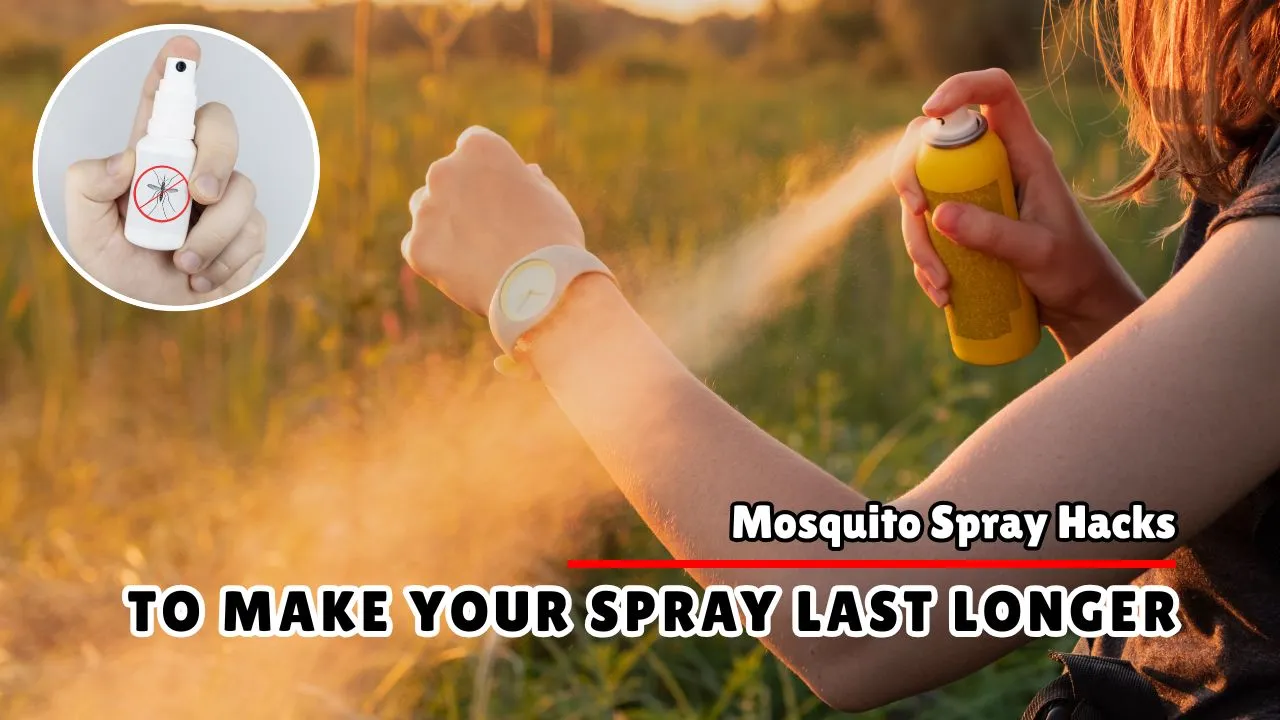
There is a certain charm about being outdoors during the evening which might include actions such as gardening, swinging on the porch, grilling with family, or simply watching stars by the fire pit. However, it is also true that the minute you hear or feel that high-pitched, annoying mosquito buzz right at your ear, the whole beautiful outdoor experience is gone.
You take your effective mosquito spray, liberally apply it on yourself from the top of the head to the feet, and finally, you get a chance to breathe a sigh of relief as the swarms move off… until the itching starts again after 30 minutes. Do you get what I mean? Have you ever thought to make your mosquito spray last longer in such times?
In fact, most mosquito sprays of different compositions such as DEET, picaridin, or natural essential oil do not always keep their effectiveness for as long as people want. The process of evaporation, your sweat, humidity, the absorption of fabric, and even how you store the product all go a long way to determine the rate at which protection disappears from the product.
As a person who chooses to live a homesteading lifestyle (where outdoor activities are part of daily life), I have picked up quite a number of lessons about resource management. Similarly, you can prolong the life of mosquito repellent with the correct methods just like you extend a harvest through canning, fermenting, and dehydrating.
To assist you in the task, I have come up with 12 very detailed hacks that are going to be the reasons for your mosquito repellent to stay effective for a longer time while you are out of your home. Meanwhile, we will briefly look at the repellency science, weigh synthetic against natural spray, and find out the tricks that most people do not even think about.
As a result, you will not have to bother with the frequent reapplication of the product anymore and will be able to maximize your outdoor time.
Understanding Why Mosquito Spray Wears Off
Before knowing the hacks, just find out the reason for the quick disappearing of the effectiveness of your spray:
- Evaporation: Spray molecules evaporate from the skin into the air. Essential oils (like citronella or lemon eucalyptus) evaporate much faster than slow-burning chemicals like DEET.
- Absorption into skin: Some repellent parts soak into skin layers and “go off” quicker if your skin is dry or cracked.
- Sweat and water exposure: Sweat removes sprays, thus less spray time is left.
- Friction: Clothing rubbing against skin (like around sock lines or shirt collars) gets rid of repellents faster.
- Heat and CO2: The hotter you are, the more attractive you become to mozzies. This leads to more bites even if your spray is partially working.
Knowing these factors helps you counter them—and this is what these 12 hacks are meant for.
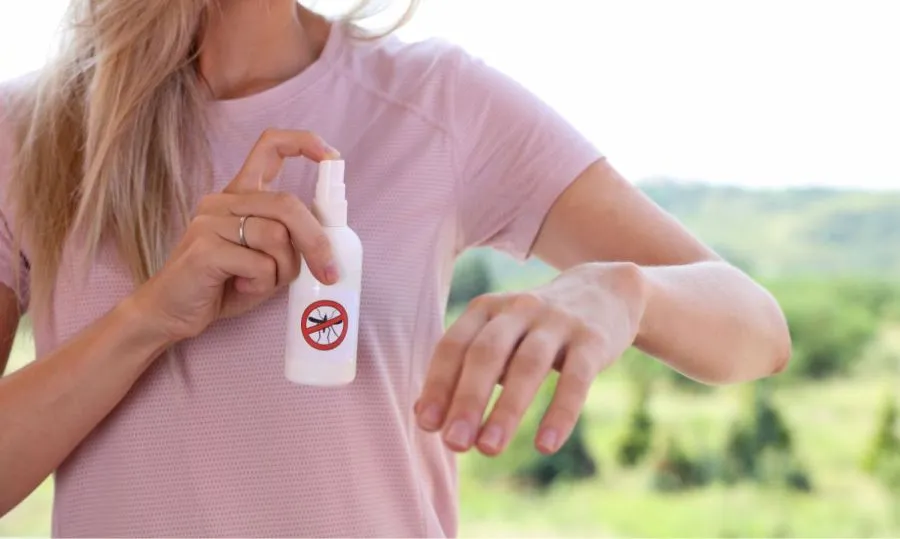
12 Hacks to Make Your Mosquito Spray Last Longer
Hack #1: Start With Clean, Dry Skin
One of the most common mistakes that people make is spraying their deodorant over their sweaty skin which is already covered with lotion. You can compare it to painting a wall, where you have to have a clean surface for the paint to adhere properly.
Why It Works
- Body sweat and oils cause the dilution of the spray, which results in thinning of the ingredients and faster evaporation.
- Moreover, lotions and sunscreens may repel or react with the active ingredients, thus, shortening the duration.
How to Do It
- Wash exposed skin with mild soap and water before outdoor activities.
- Dry thoroughly—moisture reduces adherence.
- If you plan to use sunscreen with mosquito spray, do it first and wait 15-20 minutes before you put the mosquito repellent on as the final layer.
The way I do it at my homestead is that I usually start my evenings by washing off the sweat from my day chores and then I reapply my spray. To me, this is the way my spray of lemongrass oil lasts twice as long as when I put it on my sweaty skin.
Hack #2: Spray Clothing as Well as Skin
Mosquitoes are capable of piercing through fabrics that are thin like leggings, socks, and T-shirts and thus getting to your skin to feed. So, if you spray only your skin, you are actually making it easier for the mosquitoes to reach you by leaving “gaps” in your armor.
Why It Works
- Compared to our skin, fabrics are very good in storing sprays since they do not sweat or absorb oils.
- Clothing that is treated becomes another protective barrier for the wearer and one that mosquitoes cannot easily break through.
Pro Tips
- Always remember to spray your pant legs, socks, shoes, hats and shirt sleeves especially the openings that are a bit apart from the skin.
- Use regular natural spray on your clothes and you will not feel any irritation on your skin and still get the benefit of the scent barrier that is strong.
- Furthermore, for your protection over a long period, you should get your hand on permethrin-treated clothing which is highly recommended for camping and gardening. It can be washed up to 70 times and the mosquito rating is reduced by a very large percentage.
After I have sprayed my work boots, socks, and hat, I am usually safe for a long time as compared to when I just spray on my arms and legs only.
Hack #3: Target Pulse Points and Hot Zones
Mosquitoes are attracted by body heat. Places where blood vessels are close to the skin are like brightly lit runways to them.
Key Hot Zones
- Ankles and calves: the first place for ground-level mosquitoes.
- Wrists and elbows: a combination of thin skin and heat makes them a prime target.
- Neck and shoulders: mosquitoes are near your face yet they land nearby first.
You don’t have to cover yourself with spray from head to toe if you focus on these zones first. It saves product and reapplication times.
Hack #4: Use a Barrier Lotion Underneath
This is an amazing way that combines scientific and homesteading practicality—you are more than just a repellent user, you become a user of a repellents locked in by a barrier you create with a moisturizer.
Why It Works
- Thick lotions only slow down the process of evaporation (like shea butter or coconut oil).
- They build a layer that allows the repellent substances to remain close to the skin for a longer period of time.
Method
- First, apply a fragrance-free moisturizer on your skin.
- Wait 10-15 minutes for it to be absorbed.
- On top of it, apply your repellent.
What you are doing is like priming wood before staining—your base helps the top layer last longer.
Hack #5: Reapply Strategically, Not Constantly
A person is typically scared and overdoses the first time a mosquito bites his neck or face—but this only wastes product and does not help.
Rule of Thumb
- If you are heavily sweating or swimming, reapply every 75-90 minutes.
- If you do a light activity in the shade, reapply every 3-6 hours (depending on the formula).
- Essential oil sprays are re-applied every 2 hours maximum.
By being strategic, you get the best of both worlds—you are able to stretch your bottle and stay bite-free.
Hack #6: Store Spray Correctly
Just as important as the way that you use your spray is the way that you store it. If you leave it in a hot car or a damp shed, it is going to lose its effectiveness fast.
Storage Guidelines
- Keep it in a cool and dark cupboard inside your house.
- If you are going to be outdoors for a long time place it in a shaded cooler bag.
- Always make sure that the lid is tightly sealed so that room for evaporation is not given.
The bottle that I had left in my outdoor tool shed last summer lost a lot of strength compared to the same brand stored in the pantry.
Hack #7: Apply in Wind-Free Spots
Mosquito spray is not effective if half of it gets lost in the air during the process.
Best Practice
- Wrap outdoor atmosphere like a part of the porch, or a place protected from the wind.
- Spray slowly and evenly, and rub gently into skin.
- Quick bursting sprays should be avoided as they tend to dissipate very quickly and cover only a very small surface area.
If you spray cautiously you will not need to make so many touch-ups later.
Hack #8: Add Natural Scent Barriers
You may choose not to rely just on one layer of spray and rather back up your protection with other deterrents.
Methods
- Light citronella candles on tables.
- Grow herbs such as basil, lavender, or mint in the areas where you have chairs.
- Put essential oils that you like such as rosemary or eucalyptus out of the window.
Since the number of mosquitoes that are close to you is reduced significantly, the amount of mosquito spray that will be needed now will be quiet low.
Hack #9: Dress for Defense
Your clothes are your first barrier—they not only protect your skin but also reduce the amount of spray that you need.
Smart Clothing Tips
- Wear light-colored fabrics (mosquitoes are attracted to dark, heat-retaining colors).
- Pick tightly-woven fabrics that mosquitoes can’t bite through.
- Combine with permethrin-treated gear for game-changing results.
The less skin that is left unprotected, the longer your spray works on the areas that truly matter.
Hack #10: Minimize Sweating
Sweat is the major cause of the failure of sprays.
Practical Adjustments
- Take shade breaks to reduce body heat.
- Wear moisture-wicking clothes that dry quickly.
- Only reapply after you have had a heavy sweating spell instead of on a timer.
During hay-baling season at the homestead, if I don’t take breaks in the barn, I need twice as much repellent to work in the sun.
Hack #11: Treat Gear and Surroundings
Do not limit yourself to only the skin—mice are also next to you on the surfaces you touch
What to Spray
- Chairs, hammocks, tents, backpacks.
- Pet leashes (using pet-safe sprays).
- Outdoor blankets or picnic setups.
If you become the creator of a ”mosquito-free bubble” it means that your skin spray will not work alone but that, it will be able to work for a longer period of time.
Hack #12: Make a DIY Booster Spray
Home-made sprays are not as powerful as store-bought ones, however, the use of boosters will help you to use them for longer periods of time.
Simple Recipe
- Distilled water (1/2 bottle).
- Witch hazel or vodka (1/4 bottle, helps mix oils).
- 15-20 drops of essential oils (citronella, lemongrass, lavender).
Use a small spray bottle for booster spray and keep it in your pocket. Do not spray fully with this booster, just spray lightly between full applications, this will save expensive commercial spray.
DEET vs. Natural Sprays: Duration Breakdown
| Spray Type | Average Duration Outdoors | Best Use Case | How to Extend |
|---|---|---|---|
| DEET (20-30%) | 4–8 hours | Long hikes, heavy mosquito zones | Use on clothing + clean skin |
| Picaridin (20%) | 4–6 hours | Comfortable alternative to DEET | Perfect with sweat control |
| Lemon Eucalyptus | 2–4 hours | Eco-friendly daily use | Reapply every 2 hours |
| Citronella Oils | 30–60 mins | Quick outdoor chores | Boost with candle/herb backup |
Final Takeaway
It is not really in buying the strongest formula that you can make mosquito spray last longer in the outdoors. The secret is layering the strategies. By cleaning your skin, protecting clothing, managing sweat, treating gear, and using supplemental barriers, you can extend the effective life of your repellent double (sometimes, triple).
On the homestead, it is not an option to use these hacks during the summer when you have to work outdoors daily. They have become my survival tools. I can spend whole evenings taking care of animals or harvesting garden beds without being constantly interrupted by buzzing swarms, all because I layer my defenses smartly.
I should be able to use my spray for the whole season without having to reapply it more than what I feel is a waste of the spray. Implement these 12 hacks, and your outdoor nights will not be a fight with insects anymore but a peaceful and uninterrupted time.
