
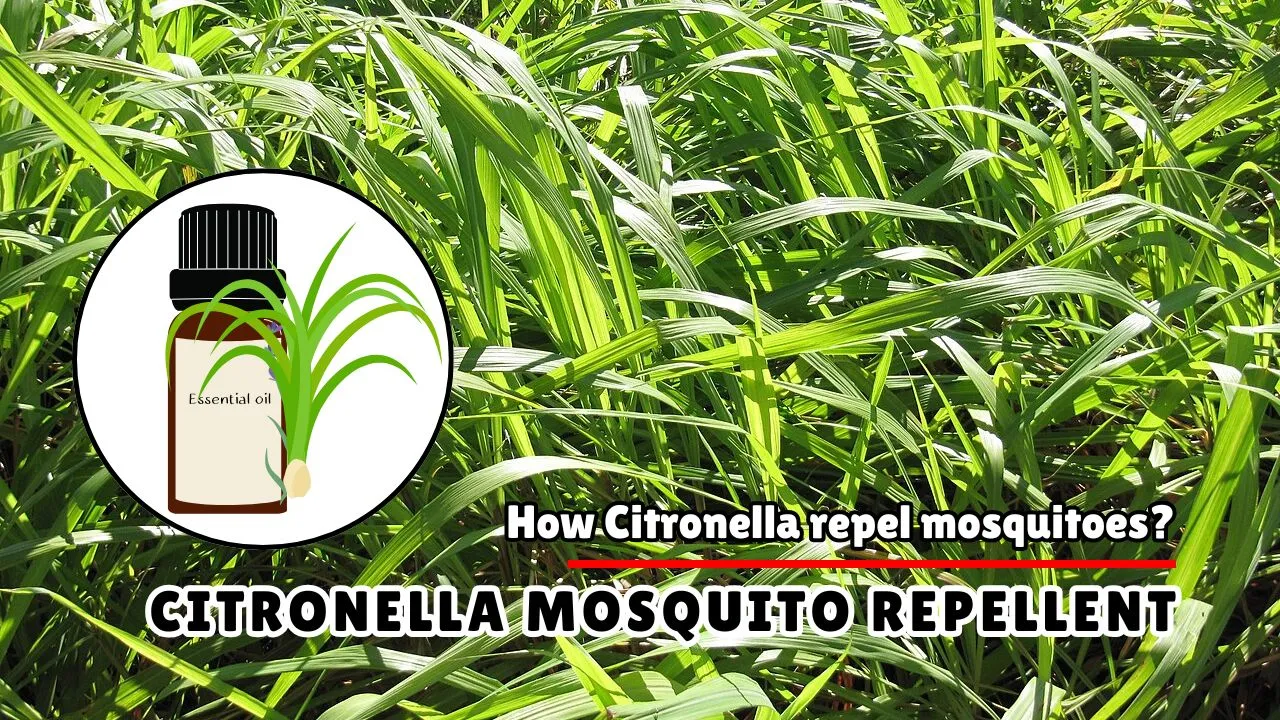
Citronella primarily repels mosquitoes by hiding the odors that attract them and by disrupting their ability to find hosts through interference with their smell receptors. This article offers a thorough scientific explanation of the repellent mechanism of citronella along with the insights into its chemical profile, effectiveness, and practical usage and clearly explains actually how does citronella repel mosquitoes.
Citronella Oil: Introduction and Origins
Citronella oil is one of the most popular essential oils in the world obtained from the leaves and stem of the grass Cymbopogon species mainly Cymbopogon nardus (Ceylon citronella) and Cymbopogon winterianus (Java citronella). It was the most popular oil in the world for its strong citrusy aroma and its very good insect repellent properties especially in backyard spraying against mosquitoes and other insects .
Due to the fact that citronella is a great repellent, it has been also extensively used in the formulation of sprays, lotions, candles, gels, and diffusers that are intended for indoor and outdoor settings. The United States Environmental Protection Agency (EPA) regards citronella oil as a non-toxic insect-repellent which is the part issued from nature and it has a non-toxic mode of action, thus it is an option that is easily acceptable for eco-friendly pest control.
The Science of Mosquito Attraction
Mosquitoes are able to identify their victims by the presence of carbon dioxide (CO₂), lactic acid, heat from the body, and whole a cocktail of volatile organic compounds emitted by human skin. Their antennae and maxillary palps are equipped with olfactory receptors that are specialized in locking onto the chemical signals and thus, they are able to pinpoint their target closely.

How Does Citronella Repel Mosquitoes?
A. Olfactory Disruption
One of the ways in which the oil of citronella repels mosquitoes is by interfering with the mosquito’s sense of smell — more specifically, by temporarily “jamming” their olfactory system so that they cannot track human scents as they normally do.
- Citronellal, citronellol, and geraniol which are the mainly active compounds (citronella active ingredients) attach themselves to the odorant receptors on the mosquito’s antennae.
- Through this blockade, the mosquito’s capacity for recognizing or focusing on frequently used attractants like CO₂ and lactic acid is altered.
B. Masking Human Scent
With strong-smelling volatile compounds in the air, citronella basically “masks” the signals that the mosquitoes depend on to find a host. The essential oils’ overpowering scent completely fills the mosquito’s receptors, forcing them to leave the treated areas or surfaces as they cannot find a place for themselves.
Affecting Mosquito Behavior
Research indicates that being exposed to citronella results in the decrease of host-seeking and feeding behavior in Aedes aegypti, Anopheles dirus, and Culex quinquefasciatus mosquitoes. Y-tube olfactometer experiments display significantly reduced activity and biting rates when the mosquitoes are exposed to citronella vapors, hence, the attraction mechanism is interrupted.
Citronella Chemical Composition (Citronella Active Ingredient)
Citronella oil’s effectiveness is attributed to a blend of several compounds:
- The effectiveness of the repellent depends largely on the accurate composition and concentration of these chemicals.
- On one hand, it is known that the use of citornella, vanillin, and patchouli in one formula extends the duration of protection and increases the overall effectiveness.
Citronella Mosquito Repellent: Scientific Studies and Repellent Efficiency
Laboratory Findings
One of the things to be considered when assessing the effectiveness of the repellent is the extent to which it discourages the bites and the time of the protection:
- Citronella oil is repellent 100% for up to 3 hours at 25% concentration against Aedes aegypti and Anopheles dirus.
- Efficacy is dose-dependent; lower concentrations normally would give shorter protection periods, but mixtures can increase results significantly.
- In a comparison with DEET (the gold standard repellent), citronella is usually less effective for a shorter time, but the use of vanillin as a fixative can make the action last longer.
Field and Product Studies
The product formulations have a big impact on the performance in the real world. Citronella candles, sprays, gels and nanogels offer different levels of protection:
- Candles and incense offer a moderate level of relief outdoors, but are not very effective in the presence of wind.
- Gels made from nano-encapsulated citronella can be used to regulate the rate of evaporation, prolonging the release and the utility for indoor use.
- In controlled trials, products derived from spray with 50% citronella oil showed kill rates of mosquitoes close to total.
- Citronella reed diffusers and bath bombs can be highly effective (65–85%) in indoor or environments with limited airflow.
Duration of Protection
Mode of Action: Citronella as a “Mosquito Repellent”
Citronella, in contrast to toxic insecticides, does not kill mosquitoes abruptly (only at very high concentrations); it avoids them by:
- Overcoming and shutting off the receptors of mosquitoes.
- Making treated skin or airspaces unrecognizable as targets for landing and feeding.
- Reducing the number of mosquito encounters and bites without any negative effect on the ecological system — an important advantage in nature and child-safe repellent methods.
Safety Profile and Environmental Impact
The Environmental Protection Agency (EPA) allocates citronella oil the status of “Generally Recognized as Safe” for topical use and the environment, with no or very few adverse effects. For mammals, the oil is non-toxic and does not accumulate in the food chain, thus making it more friendly to nature for mosquito management.
- In very few cases, skin irritation can be caused, but it is almost impossible for systemic toxicity to happen.
- Repellents that are plant-based such as citronella break down fast in nature and therefore leave no harmful residues.
Citronella Versus Chemical Repellents
DEET and picaridin are the leading way to maximum protection for the longest time, yet consumers are still attracted by citronella for the following reasons:
- Consumers who demand natural and plant-based alternatives to synthetic repellents.
- Biodegradable protection that is in harmony with the sustainability and wellness niches.
Citronella Oil in Mosquito Control Products
Citronella is the main ingredient in many commercial and homemade products such as:
- Reed diffusers and oil burners made for small rooms.
- Sprays and lotions that are for the direct application of the skin.
- Candles, coils, bath bombs, and gel packs for protecting the outdoors and the bathroom.
- Nano-encapsulation that allows for slow-release formulations.
Application Tips for Optimal Mosquito Protection
Enhance the potency of citronella by doing the following:
- Expose the skin and wear the treated clothes, but do not apply near your mouth or eyes.
- Reapply every 1–2 hours, or sooner if sweating or swimming.
- Combine with physical barriers (screens, bed nets) for best results outdoors.
Limitations and Complementary Strategies
One can use citronella only in situations where protection is required for a short period of time, in low-risk areas, and eco-friendliness matter for skin sensitivity as it has a shorter window of protection. For places with a lot of mosquitoes or where there is a chance to get a mosquito-borne disease, it is advised to either combine citronella with stronger repellents or use integrated pest management.
Conclusion
Citronella keeps mosquitoes away by using its unique combination of volatile compounds (Citronella active ingredients) to mislead and disrupt the insects’ odor molecules, repellents most notably citronellal, citronellol, and geraniol. It hides the human attractant signals and deters host-seeking through receptor blockade thus, it is an excellent natural, safe, and ecologically friendly alternative to chemical repellents and thus primarily referred for eco-friendly insect control.
Despite its action duration that is commonly shorter than DEET, the use of citronella continues to be for consumers who are aware of it and situations where plant-based products are preferred.
Citronella mosquito repellent is an indispensable mosquito management tool of the present due to its various uses in sprays, gels, candles, and nano-formulations, which are all coupled with minimal side effects and biodegradability. It is recommended to use citronella mosquito repellent for everyday protection, short-term outdoor activities, or combined with other non-toxic strategies to keep mosquitoes at bay.
